Direct answer
Define what will be checked and who can release the shipment
Build a custom scarf inspection plan from the approved sample and written specification. Define the product and lot, appearance and measurement checks, any required laboratory evidence, the inspection stage, reporting format and release authority. If an acceptance-sampling plan is used, identify the method and decision rules explicitly; an AQL label alone does not describe a complete plan. Record defects with quantities and photographs, then resolve them under the agreed order terms. Inspection, product testing and certificate verification answer different questions.
Buyer scenario
Example: an inspection can pass while the wrong requirement was checked
Consider a hypothetical shipment checked for visible stains and loose threads while the buyer’s main concern is rubbing against a light-coloured uniform. A clean visual inspection would not establish the required colourfastness. The lesson is to map each risk to an appropriate check before production, rather than asking one inspection report to answer every quality question. This is an illustrative example, not a reported defect case.
Start with the approved specification and the lot to be inspected
Identify the product codes, styles, colourways, quantities and current specification revision. Make the approved sample or other agreed reference available to the inspector. If the material, artwork or packaging has changed since approval, resolve the reference before inspection. A report cannot reliably judge conformity when the buyer and supplier are using different versions.
Define the lot and how its contents will be identified. Several colourways or materials may need distinct observations even when shipped together. State which features are critical to the order and which variations have already been accepted. Do not leave the inspector to invent an acceptance standard from a product photograph or a general description such as premium quality.
Write product-specific appearance and measurement checks
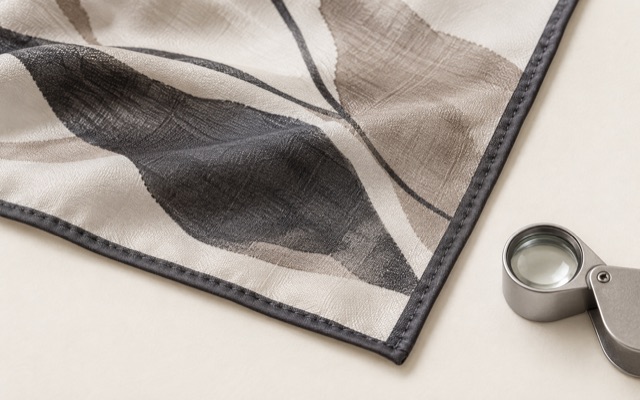
Include print placement, border alignment, essential text, visible marks, holes, pulls and the relevant front-and-reverse appearance. For construction, identify the selected edge, corners, stitch condition and label attachment. Use photographs or marked references where words can be interpreted differently. Each check should lead to an observation that can be recorded.
For size, state the measurement points, product condition and agreed tolerances. Keep finished-size measurement separate from dimensional change after a specified treatment. If shrinkage or another performance question matters, ask the appropriate laboratory or technical adviser to confirm the test method and conditions. Do not replace that work with an arbitrary tolerance copied from a different textile product.
Set the SCARFTEX inspection scope in writing
SCARFTEX finished-product checks cover colour and print clarity, dimensions, hemming and stitching, loose threads, and visible defects such as stains or damage. Use the approved product reference to identify what must be recorded for each item.
Pre-shipment inspection arrangements and inspection documentation are agreed for the project. Customer or third-party inspection arrangements and costs are agreed per order. Specify any sampling standard, defect classification, acceptance limit, laboratory work or certificate requirement separately; the listed visual checks do not establish those results.
Separate visual inspection, performance testing and certificates
Inspection can document the visible or measurable characteristics covered by its plan. Laboratory testing may be needed for fibre composition, dimensional stability or colourfastness. Intertek’s textile-testing information identifies these as separate areas of evaluation; its colourfastness guidance distinguishes exposures including rubbing and perspiration. Select the relevant tests for the product and intended use instead of requesting a generic quality report.
When a certificate is supplied, check its holder, scope, validity and relationship to the material or finished product. The official issuer’s verification route is preferable to accepting a logo alone; OEKO-TEX provides a Label Check for its certificate numbers. A company or factory document must not be assumed to cover every item in the order. This guide does not claim that SCARFTEX holds a particular product certificate.
| Evidence type | Question it can address | Boundary to confirm |
|---|---|---|
| Product inspection | Do the inspected items meet the defined visible and measured requirements? | Lot, stage, sample selection and acceptance rules |
| Fibre-composition report | What composition did the identified submitted specimen show? | Specimen identity and relationship to the ordered material |
| Performance test | How did the specimen perform under a stated method? | Method, conditions, result and agreed requirement |
| Certificate or audit | What named scope was verified by the issuing scheme or auditor? | Holder, covered product/site, validity and current status |
Reference: Intertek: Textile testing services; Intertek: Colourfastness testing; OEKO-TEX: OEKO-TEX Label Check
Agree the inspection stage, sampling approach and authority
Decide whether checks are needed during production, before packing or before dispatch, and which checks should be independent. If sampling is used, obtain a complete plan from the qualified inspection provider: the applicable method, lot basis, selection approach, defect classifications and acceptance/rejection rules. Do not treat a single AQL number as a promise that every unit is defect-free.
Name who commissions the inspection, pays the agreed fees, receives the report and authorises release. At SCARFTEX, customer or third-party inspection arrangements and costs are agreed per order. Avoid assuming that an optional inspection is included in the unit price. Confirm any required reinspection and the consequence of an unresolved finding before the goods are due to leave.
Record findings and resolve them against the order
A useful defect record identifies the order and lot, affected style or colourway, observed quantities, specification reference and photographs that show the concern. Distinguish a measured nonconformity from a preference that was never part of the agreed requirement. Keep the original evidence when discussing a correction so later messages do not lose the basis of the finding.
Agree the action, responsible person, verification step and release decision in writing. A response could involve further checks or an agreed correction, but the remedy must follow the actual order terms rather than an invented universal refund policy. SCARFTEX reviews quality concerns from the supplied details and agrees handling per order. A clear record supports that discussion and helps the next production run use the corrected reference.
Review checklist
- The lot and approved reference are identified.
- Appearance and measurement criteria are written.
- Laboratory requirements are separate from visual checks.
- Sampling and decision rules are agreed where used.
- The report recipient and release authority are named.
- Defect evidence, action and follow-up verification are retained.
Custom scarf inspection planning record
Use the inspection planning record to agree what will be checked, how results will be recorded and who can release the shipment. The worksheet has no preset AQL, tolerance or pass grade; those belong to the agreed product and inspection scope.
Frequently asked questions
Does an AQL number alone define the inspection?
No. The plan also needs a lot basis, sampling and selection approach, defect definitions and decision rules agreed with the inspection provider.
Can visual inspection prove colourfastness?
No. Visual appearance and resistance to exposures such as rubbing or perspiration require different evidence.
Can I arrange a third-party inspection?
Discuss the scope, timing, access, fees and release responsibility for the specific order. SCARFTEX confirms these arrangements per order.
Does a certificate cover every product from a supplier?
Do not assume that it does. Check the named holder, product or site scope, validity and relationship to the ordered item.
Primary references
Sources used for technical context
These sources support the general technical or regulatory context. They do not prove SCARFTEX capability, certification or the specification of a particular order.
- Textile testing servicesIntertek
Distinguishes textile performance checks. Test selection, methods and acceptance criteria need a product-specific brief.
- Colourfastness testingIntertek
Explains exposures such as rubbing and perspiration; no universal pass grade is asserted here.
- OEKO-TEX Label CheckOEKO-TEX
A verification route when a supplier supplies a certificate number. This is not a statement that SCARFTEX holds that certificate.