Direct answer
Approve named features against one identified sample
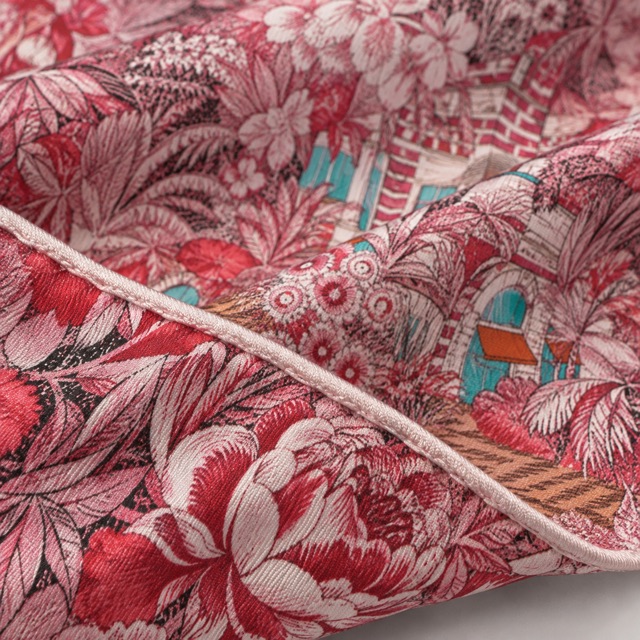
Before approving a custom scarf sample, match it to the artwork and specification revision, then check material, finished dimensions, print, colour, edge, branding and packaging where included. Record each item as approved, requiring change or outside the sample’s scope. Photographs support the record but cannot prove every physical property. A general message such as looks good leaves too much open. The useful outcome is a retained sample and a written decision that purchasing and production can interpret in the same way.
Buyer scenario
Example: approval of appearance is not approval of every detail
Consider a hypothetical buyer who approves a photograph of the scarf print before the woven label and gift sleeve are final. If the team then treats the entire product as approved, unresolved packaging and placement decisions can reach production unnoticed. A sample record that identifies the approved features and the remaining checks keeps a partial decision from becoming a blanket release.
Identify the sample and the decision it can support
Record the product code, sample identifier, date received, artwork version, colourway and specification revision. State whether the item is a fabric swatch, print strike-off, construction sample or complete pre-production sample. Different sample types answer different questions. An unprinted swatch cannot approve a brand colour, and a printed panel cannot approve a sewn corner.
Give the reviewers the same brief and references. If the specification is incomplete, note the missing information before inspection. Do not allow the sample to define an important requirement by accident. A buyer may like the appearance while still needing to confirm composition, dimensions, care information or the quantity and scope represented by the sample.
Check the physical product against written requirements
Examine the material reference and construction, then measure the finished dimensions using the method agreed for the product. State the condition of the item and the measurement points. Review the edge, corners, stitch formation, loose threads, puckering and any visible damage. Tolerances should come from the agreed specification rather than a convenient number found in another supplier’s article.
Test the intended wearing or presentation method. A narrow tie, headwrap and large square can expose different parts of the print and reverse. Note whether the product works in the priority use, but do not turn one handling session into a laboratory performance claim. If a property needs testing, identify the test requirement and the material or product to which the result must relate.
Review print and colour against the correct reference
Compare the artwork version, motif placement, border relationship, essential text and visible print detail. Use the agreed physical colour reference under consistent viewing conditions. A monitor or email photograph may help describe a concern but should not silently replace the reference chosen for approval. Mark the location of any issue so that the requested correction can be understood.
Keep visual colour approval separate from colourfastness evidence. A scarf can look correct at the approval meeting while its behaviour under rubbing, perspiration or cleaning remains untested. Intertek describes these as distinct exposure-based tests. Where they matter to the intended use, agree the relevant method and requirement rather than assuming that visual approval covers them.
Reference: Intertek: Colourfastness testing
Review the complete ordered presentation
If labels and packaging are part of the order, identify their artwork versions and check them on the finished product. Inspect orientation, placement, essential information and how the scarf fits into the presentation. A flat box design does not show every aspect of the packed item. Record any component represented by a mockup rather than a production-equivalent sample.
If the sample excludes a label, insert or shipping pack, mark that item as still open and assign its approval step. The purpose is not to demand every possible sample at once. It is to avoid treating an attractive partial sample as evidence for components that nobody has examined. Keep packaging and product decisions linked to the same order revision.
Write a decision that can release, revise or hold the next stage
Use a short table with a requirement, observation, decision and action owner. Separate changes that require another sample from minor updates that can be verified by an agreed alternative record. The buyer and supplier should decide that route explicitly. Do not leave a critical change as a comment underneath a general approval.
Retain the physical reference and the final record, including accepted limitations. If a fabric, artwork, print route or component changes afterward, identify which approvals must be revisited. For SCARFTEX, sample timing and charges are confirmed per project. Approval of the sample is one condition for the bulk-production schedule; it does not by itself confirm that all commercial and production-start conditions are complete.
| Review item | Record against the sample | Possible next decision |
|---|---|---|
| Identity and scope | Sample ID, specification revision and excluded features | Proceed with review or clarify the reference |
| Material and dimensions | Sample reference, measurements and observations | Approve or request a defined correction |
| Print and colour | Approved file, physical reference and marked concerns | Approve, resample or agree another verification step |
| Labels and packaging | Component versions and actual packed appearance | Approve included items and keep missing items open |
| Final release | Reviewer, decision date, exceptions and actions | Release the agreed stage or hold pending actions |
Review checklist
- Identify exactly which sample is being approved.
- Review the actual product, not only its photograph.
- Keep visual approval and laboratory evidence separate.
- Record exclusions and unresolved changes.
- Retain the sample and approval together for production.
Can a Print Strike-off Approve a Scarf’s Full Pattern and Border?
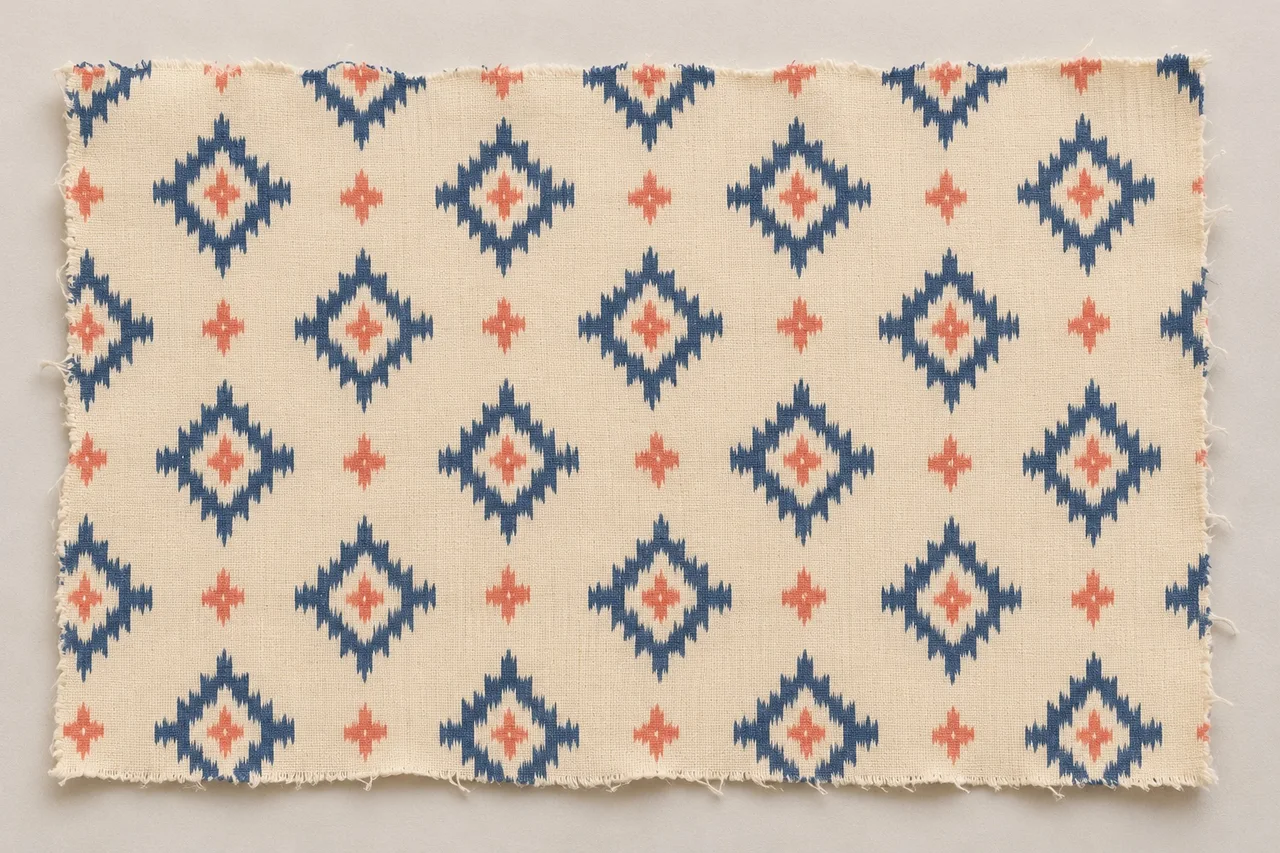
A print strike-off can support approval of the features it actually contains. A small swatch can show how a colour, fine line or background prints on the specified fabric. To approve the complete border, the sample needs to show the relevant layout at the right scale. To approve how that border meets a finished corner, request a sample with the intended hem. Treat each decision as a separate line on the approval record.
Ask what the sample is meant to prove
The term strike-off is useful only when everyone knows what was printed. Before approving, identify the artwork version, fabric, colourway, printed area and scale. A test that uses the correct motif on a different fabric can help you discuss the file, but it gives you less evidence about the final print on the intended fabric. Confirm whether the sample uses the intended production print route and whether anything important will change before bulk.
Say which part of the design matters most. A block of background colour might be enough to compare the colour with an agreed reference. A portion of the fine line work can reveal if a detail becomes difficult to see. An uninterrupted section of the border can show whether its colours or line weights work together. Each of those checks is useful even if the sample cannot answer whether the finished scarf looks balanced.
Give the print team a marked artwork map so it can tell which areas must be included. A square scarf might need a corner, a fine signature, a quiet background and the junction where a pale motif meets a dark frame. If they cannot fit on one small test, decide whether to enlarge the printed area or request clearly labelled sections. Keep the scale of each area visible in the approval record. Scarf artwork and production files
Distinguish a full repeat from a full scarf
If the print is an all-over repeat, check whether the strike-off shows one complete repeat and enough of the adjacent pattern to inspect the join that matters. A small fragment of a leaf or stripe can show print detail, while the spacing or transition between repeated motifs may sit outside that fragment. Kid and Hemtex, for example, require a full repeat for patterned samples in their published home-textile supplier instructions. That is one buyer’s specification and a useful prompt for what to request when a repeat is critical to your scarf. Kid and Hemtex sample routine
A placed square has another set of decisions. A central illustration and four framed corners may never repeat. A full repeat of the inner texture does not show how the illustration sits in the square, where the signature lands or how the four corners relate to each other. A scaled layout proof can help the team check composition early. A full-size print on the selected fabric is the next question if the actual spacing, visual weight or placement must be seen at size before sewing.
For a long scarf, inspect the ends as well as the centre. A swatch cut from the middle can miss a change in motif direction, the end border or the seam between two artwork areas. Mark both ends on the layout when the two ends differ. Then tell the supplier which of those areas needs to be included in the physical test.
Check the border where the print meets the hem
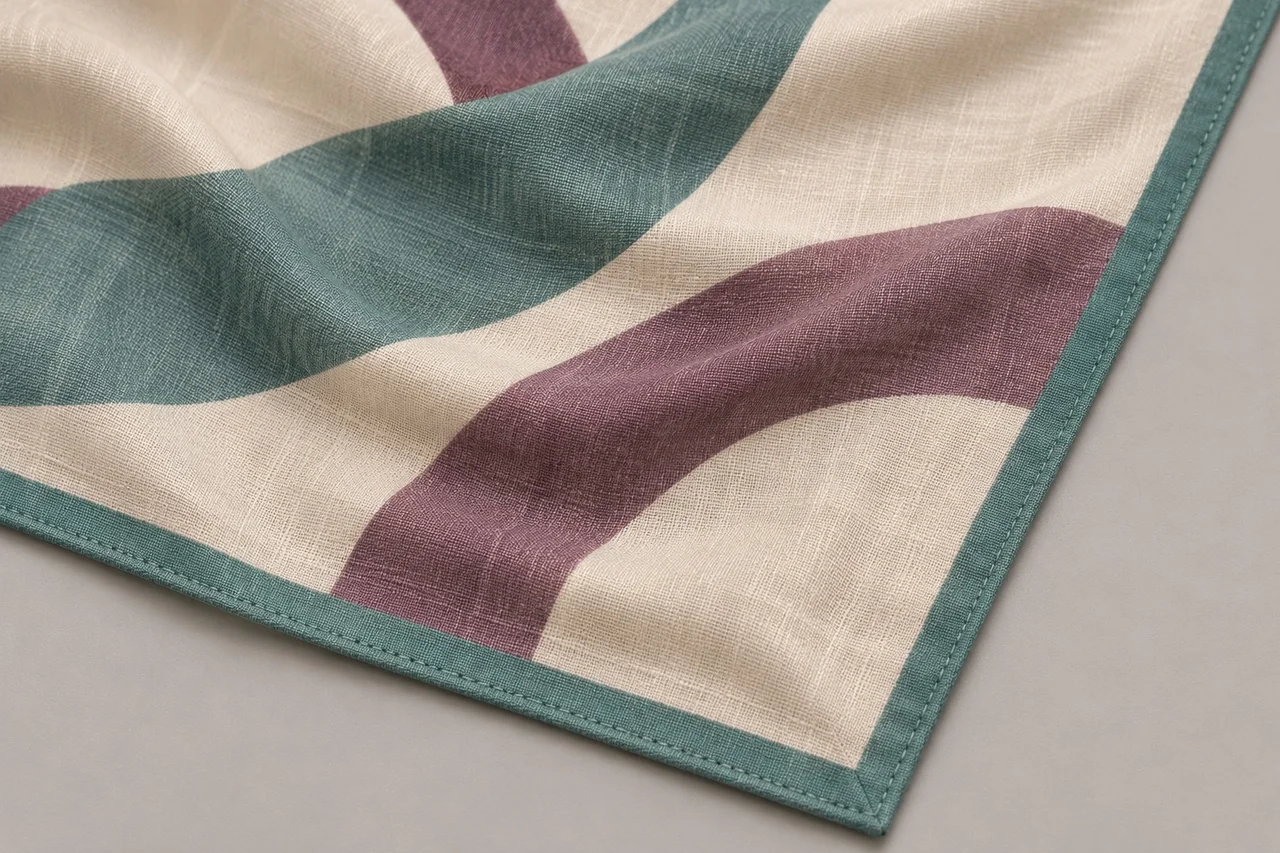
A border can be even on an uncut print and look different once the scarf is trimmed and hemmed. The artwork boundary, cut line and visible finished edge are different reference points. Confirm which width you want to measure and where you want it measured. Ask the supplier to show the artwork and cut allowances for the proposed finish. Use a finished sample when approval depends on how much of a stripe remains visible, whether both edges meet cleanly at the corner or how the cloth sits after sewing.
Look at a corner with the scarf flat, then fold it in a way people are expected to wear it. A signature close to the border may be visible on a flat artwork proof and hidden in the knot. A bright band may look narrow flat and occupy much more of the visible folded surface. Photograph the fold if it helps identify the check, then record the reference sample, fold and view that control the decision. How scarf artwork changes when folded · Hand-rolled and machine hems
If the design has a very thin frame, agree how you will compare the four sides and what variation you can accept. The assessment may differ for a deliberately irregular drawn border and a narrow geometric line that is supposed to appear continuous. Describe the requirement on the drawing and judge the intended construction on a relevant sample before fixing an acceptance limit for bulk.
Choose the least sample that answers the open question
| Decision | Ask for | Confirm before approval |
|---|---|---|
| Colour, line detail or small motifs | Targeted print strike-off | Intended fabric, print route, artwork version, scale and comparison conditions |
| Continuity of a repeating pattern | Printed area with the full repeat and relevant join | Repeat size, direction and the transition between repeats |
| Placement of motifs and four borders | Dimensioned layout proof and, where physical scale matters, a full-size print | Actual scale, centre position, orientation, border widths and corner layout |
| Visible border after finishing | Finished sample with the intended cut and hem | Finished dimensions, visible border and all relevant corners |
| Appearance when worn or displayed | Finished sample folded in the agreed way | What remains visible, where the logo lands and whether the intended presentation works |
Ask what the quoted sample includes before you choose. Depending on the project, you may settle artwork layout on screen and use one representative physical sample to check the remaining details. If the print route or base fabric is still undecided, use the first test to compare only those options. Once the fabric is chosen, decide which previous approvals can still be relied on. Scarf sampling routes, fees and timing
Approve by feature and record what is still open
Write the approval so the next person can use it without guessing. For example, in a hypothetical order you could record that a named test on the intended fabric is approved for the dark background and fine motif at actual size, while corner alignment and finished border width remain open until a hemmed sample arrives. Keep the accepted sample reference and artwork revision together. If someone changes the fabric, layout, cut line or hem after approval, ask whether the affected decision needs another check.
Set an owner for each open item. The designer may clear the motif position while the production team confirms the cut allowance and the buyer reviews the finished width. Record who signs off each point and which sample they saw. That makes it possible to move one decision forward without treating the whole scarf as approved.
When planning a SCARFTEX sample, provide the full artwork, intended dimensions, fabric direction and hem, along with a marked list of what must be shown. The approval scope and physical sample requirements are agreed by project. Tell us whether you need a print check, a full-layout check or a finished-edge check so the sample can be discussed against the actual decision. Custom scarf sample approval · Discuss a scarf project
Sample review and sign-off record
Complete the sample sign-off record against the physical sample and current specification. Mark excluded components and unresolved tests explicitly, then identify the exact stage your decision releases.
Frequently asked questions
Can a sample photograph approve the entire scarf?
Only the features that the agreed review method can establish. A photograph cannot fully verify hand feel, dimensions or untested performance.
Should every change require another complete sample?
Agree the appropriate verification for the specific change. Critical or interacting changes may need a new physical sample; do not assume a universal rule.
Does sample approval start bulk production immediately?
Not automatically. Confirm final artwork and specifications, the agreed payment condition and the order-specific production plan.
Can one corner swatch approve all four corners?
Only if the approval is limited to the features the swatch represents. Where corners differ in artwork, orientation, stitching or placement, check the remaining corners on the layout or on the finished sample appropriate to the decision.
Can I approve the border from a digital mockup?
You can use a dimensioned mockup to review artwork placement and planned proportions. Use an appropriate physical sample if you need to see how the border prints at size or how much of it remains visible after trimming and hemming.
Do I always need a full-size print?
Choose the sample based on the open decision. A targeted strike-off may answer colour or fine-detail questions. Ask for a larger printed area if the repeat join, layout or other relevant feature is outside the smaller sample.
What if the supplier changes the fabric after I approve the strike-off?
Ask which checks the change affects. Colour, surface appearance and fine detail may need to be reviewed on the new fabric. Record which prior approvals remain valid and which require another sample or reference.
Does a full-size print count as a finished sample?
It can show the full composition and printed dimensions. If it has not been cut and finished to the intended specification, it cannot show the actual finished edge, corner, completed dimensions or wearing presentation.
How do I give a useful approval in writing?
Name the sample, artwork revision, fabric and scale. List what you approved, what must change, and what is still open. Specify the sample or drawing required for the next decision.
Primary references
Sources used for technical context
These sources support the general technical or regulatory context. They do not prove SCARFTEX capability, certification or the specification of a particular order.
- Colourfastness testingIntertek
Explains exposures such as rubbing and perspiration; no universal pass grade is asserted here.