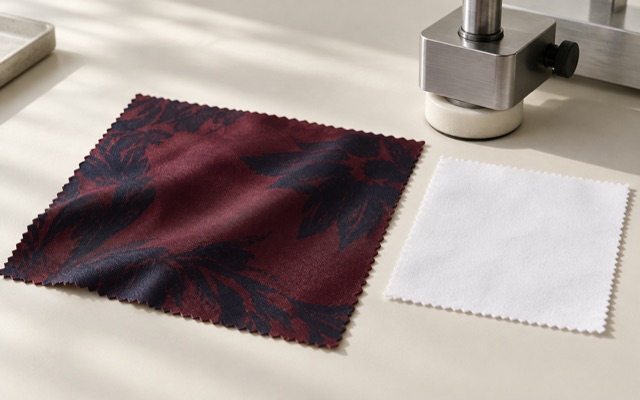
Direct answer
Start with the decision, then verify the specification.
If a dark or saturated scarf may touch a pale shirt, damp hair, skin or a uniform collar, colourfastness should be written as a product requirement rather than left as a general request for ‘good colour’. Define the material, print or dye route, end use and risk condition first. Then agree which test methods and acceptance criteria apply, whether the requirement covers colour change, staining of an adjacent material, or both, and which sample or production lot will be tested. Dry rubbing, wet rubbing and perspiration are separate exposures; one result does not stand in for the others. The buyer should approve the visual colour and the performance requirement as two related but distinct decisions, and should receive a report that identifies the tested article and method rather than a generic certificate.
Buyer scenario
Why this question changes the order.
A uniform buyer chooses a deep burgundy scarf to sit against a white blouse. The strike-off looks accurate and the first sample feels right, so colour is approved from appearance alone. During a warm launch event, moisture and repeated movement at the collar create a risk the screen review never addressed. The useful question is not whether every dark scarf will transfer colour; it is whether this exact material, colourway and process has been assessed under the contact conditions that matter. That changes the brief, the test request and the approval record before bulk production starts.
Separate visual colour approval from colourfastness
A print can match an approved physical reference and still need a separate performance assessment. Visual approval asks whether hue, depth, contrast and placement are acceptable on the selected fabric. Colourfastness asks how well that colour resists a stated exposure and whether it stains another material. Combining the two into one sentence such as ‘colour approved’ hides which decision was actually made. Record the artwork and colour reference for appearance, then write the exposure, method and acceptance rule for performance.
This distinction is particularly important with saturated grounds, dense borders and scarf programmes designed to sit against pale garments. Fibre, fabric construction, colourants, pretreatment, printing or dyeing, fixation, washing-off and finishing can all influence the result. The website cannot establish which route or grade is available for a project; those details and any testing option must be confirmed against the proposed specification. A result from another fabric or colourway should not be represented as proof for the article being ordered.
Translate wear conditions into the right exposure
Dry rubbing addresses colour that may rub off under dry contact. Wet rubbing adds moisture and is relevant where rain, damp hair, humidity or contact with a wet surface is plausible. Perspiration testing addresses the action of simulated human perspiration under controlled conditions. ISO 105-X12 describes dry and wet rubbing procedures, while ISO 105-E04 describes a method for resistance to perspiration. These are method families, not ready-made pass levels for every scarf.
Start with the use. A collectible square worn occasionally over a dark coat may have a different risk profile from a dark neck scarf issued with a white uniform. A headscarf worn in a warm climate creates different contact and moisture conditions from a gift scarf that remains in a box. The buyer, supplier and testing adviser should select the relevant exposures and current editions, then state specimen preparation, assessment scale and acceptance criteria in the quotation or quality plan.
Specify staining and colour change deliberately
A colourfastness report may assess a change in the specimen, staining of an adjacent fabric, or both, depending on the method. Buyers often care most about the pale blouse, lining or collar that could be marked, while a supplier may focus on whether the scarf itself still looks unchanged. The specification should identify the failure mode that matters and the material or multifibre adjacent fabric used by the selected method. Do not translate a grade into a promise without confirming what that grade describes.
The acceptance level is a commercial and quality decision informed by end use, colour depth, material and market expectations. It should not be invented in website copy or copied from an unrelated product. Ask the laboratory or qualified quality team to confirm the test method, edition, conditioning and reporting language. If the project has several colourways, decide which ones are tested and why; a pale pastel result does not automatically cover the darkest print.
Use sampling to find the risky combination
Sampling should preserve the exact variables needed for the decision: named artwork version, selected base fabric, colourway, print route, finishing route and edge construction. A visual strike-off may be sufficient for layout and colour direction but may not represent the complete finished scarf. If performance is material to the order, state whether the tested specimen will be a strike-off, a finished sample or production material and how closely it represents bulk.
A practical internal screening can reveal obvious concerns, but it should not be described as a standardized laboratory result. A controlled test provides a method and report; a wear trial provides context about the intended use. They answer different questions. Retain the tested article or a traceable reference where practical, and record any process change after approval. A change of fabric, printer, ink system, fixation or finish can justify re-evaluation rather than automatic reliance on the earlier result.
Carry the requirement into bulk control
The purchase specification should name the article, colourways, required methods, acceptance criteria, test stage, sample selection, laboratory or responsible party, report recipient and remedy path. If testing is optional or buyer-appointed, make cost and timing visible. Testing can affect the critical path, so the planned report date should sit before the relevant release decision rather than after shipment is booked.
A report is useful only when it can be tied to the order. Check product code, fibre or material description, colourway, lot or sample identification, test method and edition, result, date and issuing organization. A supplier brochure saying ‘high colourfastness’ or a report for an unspecified fabric is not equivalent evidence. SCARFTEX should confirm current document availability per project and should not imply a standing certification or universal performance level without the exact supporting record.
Respond to a concern without overcorrecting
If a test or wear review identifies transfer, first verify the article, method, condition and result before changing the whole collection. The response may involve process review, additional washing-off, a revised colour depth, another material direction, a different print route or a narrower approved use. Each option affects appearance, hand feel, cost and timing. Ask for a controlled resample of the changed variable so the team can see whether the correction also shifts the approved visual colour.
Do not solve the issue only with a broad care warning if the intended use still creates an unreasonable risk, and do not promise that a home remedy will make an unverified product safe for pale clothing. If a complaint arises after sale, retain the affected scarf and information about use, moisture, contacting garment and care. Compare that evidence with the approved specification and lot records. The purpose is a traceable decision, not an unsupported claim that every transfer is misuse or every dark print is defective.
Put the commercial decision in the quotation
Ask the quotation to show whether performance testing is included, optional or buyer-appointed. Name the colourways and stage covered, the proposed laboratory, estimated report timing and any sample quantity consumed by testing. If the method or acceptance level is still open, mark it as an action before order confirmation. This prevents a late test request from becoming an unpriced delay or from being waived informally when the launch date becomes tight.
The quotation should also state what happens if the selected colourway cannot meet the agreed requirement without a visible change. The buyer may choose a reduced colour depth, alternate material, changed print route or different use guidance, but that choice needs a new visual approval. A technically improved result is not automatically the same approved design. Preserve cost, colour and performance as three connected decisions rather than letting one team change the product in isolation.
For repeat orders, identify which parts of the evidence remain applicable and which require refresh. A retained approved sample can support visual continuity, while test frequency may depend on material source, process stability, colourway and buyer risk. Avoid promising that one historical report covers every future lot. The reorder brief should name the earlier reference, confirm that inputs are unchanged and record any decision to retest or rely on incoming and process controls.
Buyer checklist for colour-transfer risk
Review checklist
- Describe the palest garment or surface likely to contact the scarf and the expected wear conditions.
- Identify the darkest or most saturated colourways rather than testing only the easiest shade.
- Separate visual colour matching from resistance to dry rubbing, wet rubbing and perspiration.
- Name the current test method, edition, assessment and project-specific acceptance criteria.
- State whether the specimen is a strike-off, finished sample or production-lot article.
- Link every report to product code, material, colourway, sample or lot and test date.
- Define who pays, when testing occurs and which decision depends on the result.
- Reassess if material, colourant, print, fixation, washing-off or finishing changes.
Primary references
Sources used for technical context
These sources support the general technical or regulatory context. They do not prove SCARFTEX capability, certification or the specification of a particular order.
- ISO 105-X12:2016 — Colour fastness to rubbingInternational Organization for Standardization
Defines a method for dry and wet rubbing assessment; it does not set a universal scarf pass grade.
- ISO 105-E04:2013 — Colour fastness to perspirationInternational Organization for Standardization
Defines a method for assessing textile colour resistance to human perspiration.