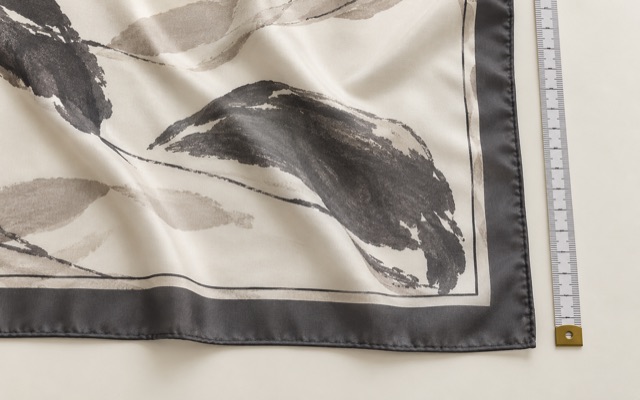
Direct answer
Start with the decision, then verify the specification.
A size tolerance is meaningful only after the parties agree what is being measured and how. State whether the number is cut size or finished size, the measurement points, whether hems are included, the shape or diagonals to be checked, the fabric condition, the surface, any relaxation period and the tool. Then define the nominal dimension, allowed variation, sample size, rounding rule, defect classification and action when a result is outside tolerance. SCARFTEX presents nominal custom size directions, but the final finished measurement method, allowance and tolerance are confirmed per order. No universal tolerance should be inferred from the website or from a reference scarf.
Buyer scenario
Why this question changes the order.
A buyer specifies a 70 cm hand-rolled square and later measures one edge at 69 cm. Production measured the relaxed finished scarf along the centre line; the buyer stretched the outside edge across a table. The values cannot be compared because the parties did not share a method. Hand finishing and flexible cloth make method discipline important. The right response is not to argue over a number but to reconstruct the agreed condition, measure a defined sample and compare the results to a written acceptance rule.
Distinguish nominal, cut and finished size
Nominal size is the commercial format name or target. Cut size is the fabric dimension before the edge construction is completed. Finished size is the agreed dimension of the completed product. The relationship depends on the construction and allowance. State which one appears on the purchase order and which one controls inspection. For rectangles, record width and length orientation; for squares, consider whether both directions and diagonals need review.
Do not assume a stated edge width means the same thing as the allowance consumed in finishing. Record finished edge or roll width, turn-in and measurement landmarks separately. If a reference sample is copied, measure and document it; the existence of the sample does not establish a repeatable tolerance by itself.
Write a repeatable measurement method
Specify that the scarf is placed on a defined flat surface in an agreed relaxed condition, without deliberate stretching or wrinkles that distort the measurement. Name the tape or ruler, units and resolution, measurement direction and points, and whether hems or fringes are included. If conditioning after packing, steaming or another preparation matters, define it rather than allowing each reviewer to improvise.
Use a diagram for unusual shapes or asymmetric products. Record the same method for samples, bulk inspection and reorders. For hand-rolled scarves, the edge may not form a mathematically rigid line; agree how the reviewer finds the measurement path. If different teams use different methods, a narrow tolerance can create false failures rather than tighter control.
Choose tolerance from product and use
There is no responsible universal tolerance for every fibre, construction, size and edge route. The proposed tolerance should consider material behaviour, finishing method, product scale, intended use, artwork placement and the practical measurement system. A scarf that must fit a packaging insert or align with a uniform specification may need a different decision rule from an oversized decorative wrap.
Record whether the tolerance applies to every measured edge, an average or another defined statistic. State rounding and boundary rules so a result at the limit is treated consistently. Decide how size variation interacts with border placement, logo position and packaging fit; a dimensional result can be within tolerance while the visible artwork is not acceptable.
Handle out-of-tolerance findings with evidence
First verify product identity, measurement method, tool and condition. Re-measure an agreed sample rather than extrapolating from one piece. Photograph the full setup and record the individual values. Compare them with the approved sample, written specification and inspection plan. Determine whether the issue is isolated, systematic or caused by a method mismatch.
The commercial response depends on severity, quantity, intended use and contract. Possible paths may include additional measurement, sorting, rework where feasible, replacement, an agreed concession or rejection, but no remedy should be promised generically. Define who reviews evidence and authorises the decision before shipment. Update the reorder record if an accepted deviation changes the reference.
When comparing measurements from two parties, exchange the raw piece-level values and setup photographs rather than only averages. Confirm that both samples came from the same identified lot. If the methods differ, align the method and repeat the review before concluding that production changed. Record the agreed result in the inspection file.
Size-control checklist
Review checklist
- Nominal product format plus clearly identified cut or finished dimensions.
- Width, length, diagonal or shaped measurement points shown in a diagram.
- Fabric condition, relaxation, surface, tool, units and no-stretch instruction.
- Whether hems, rolls, fringes or other edge features are included.
- Allowed variation, rounding, boundary and per-edge or summary rule.
- Sample size, inspection stage and defect classification.
- Artwork placement and packaging-fit checks linked to dimensional review.
- Evidence and authorisation path for any out-of-tolerance result.