Direct answer
Choose fabric and weight together, then test the finished use
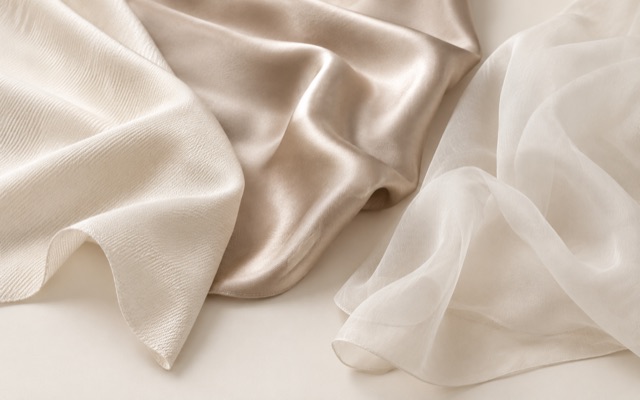
Choose silk fabric and momme weight by starting with how the scarf will be worn, its finished size and the print appearance you need. Momme is a fabric-weight reference used for silk; it is not a fibre-purity certificate or an overall quality grade. Compare the construction, surface, drape, opacity and edge on named sample options. A weight that works for a compact neckerchief may create a different result in a large wrap. Approve the combination of material, artwork, dimensions and finishing rather than purchasing a number in isolation.
Buyer scenario
Example: one collection, two different material decisions
Imagine a brand developing a small neck scarf and a large square from the same illustration. It wants the family to look coordinated, but the two sizes create different folds and knot volumes. Selecting one advertised weight for both without handling samples may hide that difference. A side-by-side comparison should test whether the collection needs one shared material or two carefully specified versions. This is a planning example, not a reported customer result.
Separate fibre, construction and weight in the brief
Write fibre composition on its own line. Silk identifies a fibre; satin identifies a construction and is not proof that a fabric is silk. Then name the construction or commercial fabric reference and the stated weight. CottonWorks describes plain, twill and satin as basic weave structures; that terminology helps separate structure from fibre, but its cotton-performance examples should not be treated as test results for silk.
Keep a supplier’s sample code beside these fields. Similar commercial names can refer to different yarns, finishes or weights. If an option is described only as premium silk, ask for the missing specification before comparing it with another offer. Where composition requires verification, use an appropriate report linked to the supplied material rather than judging authenticity from gloss alone.
Reference: CottonWorks / Cotton Incorporated: Basic woven fabric designs
Describe the job the scarf must do
Name one primary use: a compact neck tie, head covering, bag accent or larger wrap, for example. Record the intended size and how many layers are formed in that use. Ask the reviewer to look at the knot, visible border, reverse side and coverage. These observations turn vague preferences such as substantial or soft into a useful sample discussion.
List the buying priorities separately from the desired visual mood. A uniform buyer may need a clear care routine and repeatable colour; a gifting buyer may care about presentation after unpacking. Neither requirement is answered by weight alone. If a performance claim will appear on the product page or packaging, establish the evidence needed before the material is approved.
Compare plausible constructions without making a universal ranking
Use the construction names as starting points for a sample comparison. Twill has a diagonal structure; satin uses a different arrangement of interlacings. The appearance of a finished silk scarf still depends on more than that label. Charmeuse and crepe de chine are useful commercial directions to discuss, but the supplier should identify the exact fabric offered.
Review the samples under the same conditions and avoid making all variables different at once. If you compare one construction with a different weight, artwork and finish, you cannot tell which change produced the preferred result. First narrow the material candidates, then confirm the print and sewn product on the selected route.
| Comparison | What to hold constant | What to record |
|---|---|---|
| Two weight options | Construction, sample size and viewing conditions where feasible | Drape, knot bulk and layered appearance |
| Two constructions | Intended use, finished proportions and relevant artwork | Surface character, visible detail and reverse appearance |
| Printed versus unprinted material | Identified fabric reference and finishing route | Whether the print changes the appearance you approved |
| Two finished formats | Documented material and edge specification | How the same choice behaves at a different size |
Supplement · Added
Printed or Jacquard-Woven Scarves: What Should a Brand Compare Before Ordering?
Compare printed and jacquard-woven scarves by defining the design, identifying the material and reviewing representative physical samples. Examine the face, reverse, finished use and complete quotation before choosing a route. A pattern name, a product photograph or the lower unit price cannot settle all of those decisions.
1. Name the pattern route as well as the fabric
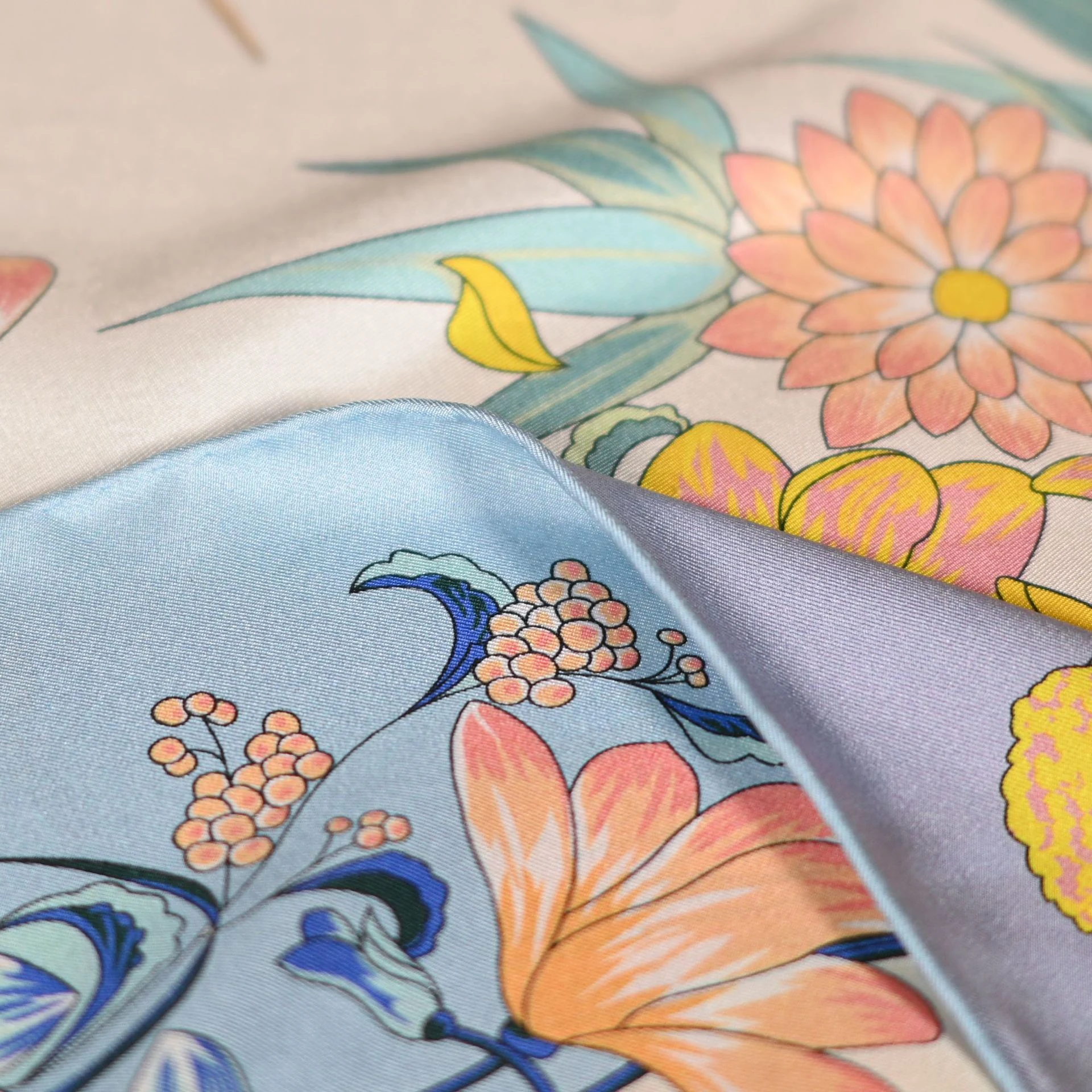
A printed scarf can be made from woven fabric. In this comparison, “jacquard-woven” means that the design is created through the interlacing of yarns during weaving. A print creates the design by a printing process. The useful distinction is how the motif is formed, rather than whether the scarf contains woven cloth. The Barbican glossary makes that structural distinction when explaining jacquard. [T01]
Record the declared fibre composition separately. “Jacquard” does not establish that a scarf is silk, just as “printed” does not establish that it is polyester. FibreGuard’s explanation also distinguishes the weaving method from the fibres used, although its upholstery performance claims are outside the scope of this scarf guide. [T02]
Ask whether the proposed product combines techniques. A figured woven base may receive an additional print, so one scarf can involve both. If that is the offer, name the base construction and the added print in the specification. A label such as “woven finish” is too vague to identify what the buyer is approving. [T03]
2. Start with one design brief, not two unrelated samples
Send both suppliers, or both development teams, the same artwork revision and intended finished dimensions. Mark the parts of the design that matter commercially: a recognisable border, a small signature, a repeat scale or a particular relationship between colours. A paisley design describes the visual direction; it does not decide the production method.
Separate requirements from preferences. For example, a border may need to remain visible when the scarf is folded into a band, while a soft tonal background may allow more interpretation. This is a planning example, not a reported customer project. Ask each team to identify the changes its proposed route would require before commissioning a sample.
Keep comparable conditions consistent where practical, but record unavoidable differences. If one candidate has a different fibre blend, weight, finish and size, the result compares two complete products. It cannot isolate the effect of printing versus weaving. That comparison may still help the buyer choose; it simply needs an accurate description.
3. Review the motif at the scale it will be sold
Ask to see the proposed motif at its intended scale. Examine small outlines, lettering, transitions between colours and the point where the border meets a corner. Rather than accepting a general promise of “fine detail”, identify the feature that needs to remain legible and review its proposed treatment.
A digital layout is useful for checking placement. It does not establish the surface, yarn effect or finished colour of a physical scarf. Ask which proof represents layout only, which represents colour and which represents the construction offered for production. Record any simplification or recolouring beside the artwork version, not in a separate conversation that production may never see.
4. Turn the sample over before approving the face
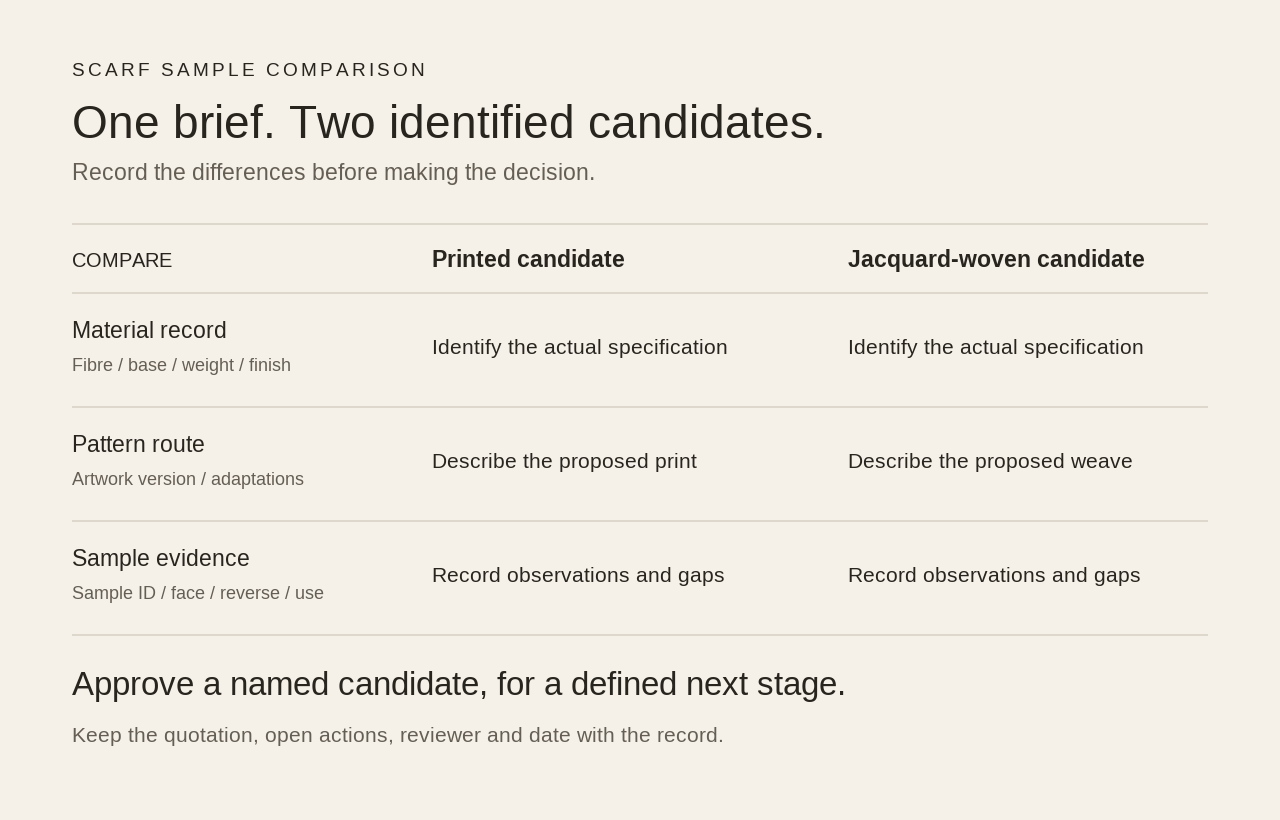
Give each sample a clear reference and inspect both sides under consistent viewing conditions. Record what the reverse actually shows, including exposed yarns, loose ends and any area that would contact skin during use. If the construction is unclear, ask the supplier to identify it against the sample code. Note the response beside the physical reference instead of treating a photograph, a familiar-looking pattern or a quick visual impression as a complete technical identification.
For a printed candidate, examine the actual reverse colour, detail and appearance at the folded edge. Do not assume that every print is pale on the back or that every woven design is suitable for reversible wear. Decide which surfaces will be visible in the intended use and whether their appearance is acceptable.
Keep visual observations separate from performance evidence. Handling can reveal an obvious loose thread or uncomfortable edge; it cannot establish a general snag-resistance or colourfastness claim. Where rubbing, perspiration, cleaning or another performance requirement matters, agree the appropriate assessment and acceptance basis for the selected product.
5. Compare the finished use, including the edge
A small swatch can help select a surface. It cannot fully show the knot volume or overall drape of a long shawl. Once a route is shortlisted, decide whether a larger development piece or finished prototype is needed to answer the remaining questions. Note the size and approval scope of whatever sample is reviewed.
Fold each candidate as the customer is expected to use it. Review the exposed border, the reverse at a turn and the way the edge sits. If one sample is unfinished and the other is hemmed, record that difference. Otherwise a preference for the finished edge may be mistaken for a preference for the pattern route.
For SCARFTEX custom development, hand-rolled and machine-hem options are discussed against the selected fabric. Artwork, specification and sample approvals are agreed for each project. These decisions should identify the product being developed; they do not make a generic material swatch an approval of every finished scarf.
6. Put development and order terms beside the unit price
Ask for a written quotation for each defined candidate. Separate development or setup charges, sample fees, unit price, minimum order basis, permitted colour mix, edge finish, labels, packaging and delivery scope. Confirm what a later reorder would reuse and what would need to be quoted again.
Supplier comparisons sometimes publish different minima and development costs for woven and printed scarves. Those are offers from the named supplier, not universal industry rules. Omnilh, for example, lists its own terms alongside the process comparison. Use that as a reminder to ask for a matched quotation, not as a price benchmark for another factory. [T04]
Keep an unsuitable option out of a lowest-price decision. A candidate that misses an essential design or use requirement needs a revision or a clear rejection reason. For the remaining options, compare the purchase commitment and included work, then confirm which approvals start production and which dates refer to dispatch or arrival.
7. Approve a named candidate and keep unresolved points visible
The decision should name the supplier, sample, artwork revision and specification it covers. State whether approval releases another development sample, approves appearance within a defined scope or authorises the agreed bulk stage. A positive comment such as “this looks good” leaves those responsibilities uncertain.
Use the record below while the samples and quotations are available. Leave missing information blank or mark it for confirmation; do not turn an unchecked field into a pass. If a supplier proposes a different material or changes the pattern route later, review the affected approvals before relying on the earlier decision.
Sample comparison record
Complete the record against identified samples and quotations. Blank fields remain unresolved. Entries stay in this browser; nothing is submitted to SCARFTEX.
Planning a printed scarf range? Share your artwork or reference, expected quantity, finished size, intended use and any physical samples with SCARFTEX. The project discussion can establish suitable printing, finishing and approval requirements. Identify any requested jacquard construction separately so feasibility can be confirmed before it is included in an offer.
Silk construction and momme options available for custom development
SCARFTEX can develop the combinations below. They are selectable custom options, not the default specification of a catalogue image or proof of current stock. Confirm the fabric reference, dimensions, print route and finish together before sampling.
For a silk twill square, 16 and 18 momme provide two available weights to compare; for a silk twill twilly, compare 14 and 16 momme. Keep the construction and intended use consistent when assessing the physical samples. These numbers do not create a universal ranking of quality or guarantee the same drape across formats.
| Product direction | Available construction | Momme options / confirmation |
|---|---|---|
| Silk square scarf | Silk twill | 16 or 18 momme |
| Silk twilly / narrow scarf | Silk twill | 14 or 16 momme |
| Silk pocket square | Silk satin / charmeuse | 14 momme |
| Silk eye mask | Silk satin or twill | 16 or 19 momme; agree the complete component specification |
| Silk scrunchie | Silk satin / charmeuse | 19 momme; agree dimensions and elastic separately |
| Silk square scarf | Crepe de chine | Weight confirmed for the selected fabric |
| Silk square or long scarf | Chiffon direction | Confirm the exact fabric reference and weight |
Continue: Compare materials, formats and edges · Plan a swatch or development sample
Use momme to identify the option, not to promise performance
Record the supplier’s stated momme value with the specific fabric reference and ask how it is controlled. Do not turn a heavier value into an automatic claim of greater luxury, durability or suitability. Nor should the mass of one finished scarf be used as a shortcut for comparing fabric weight when the dimensions and construction differ.
Ask for the available combinations rather than assuming every weight can be supplied in every construction. For SCARFTEX custom development, material, dimensions, weight and feasibility are confirmed against the project brief. Confirm the available construction-and-weight combination before including it in a product brief or requesting a sample.
Approve a material record that can be used for sampling and quotation
Label each swatch and write the observations while the comparison is in front of the reviewers. Photograph it for identification, but keep the physical reference when hand feel or drape matters. A photograph viewed on another screen cannot carry every material decision. Note any aspect that remains untested rather than treating the swatch as a complete approval sample.
The final selection should feed one quotation and one sample brief. If the fabric changes later, review affected colour, opacity, dimensions, edge and care assumptions. That small discipline is more useful than repeating a preferred fabric name while the underlying product changes between design, purchasing and production.
Review checklist
- Record fibre composition and the supplier’s fabric code.
- Name construction and stated momme separately.
- Compare at the intended finished size and use.
- Identify print, edge and care questions still to be tested.
- Retain the approved material reference with the order version.
Fabric comparison record
Use the fabric comparison record to label each swatch and record observations under the same conditions. Enter only the construction and weight supplied for that specific candidate.
Frequently asked questions
Is a higher momme always better for a scarf?
No. Weight is one part of the specification. Compare the intended size, use, construction and physical sample before choosing.
Does satin mean silk?
No. Satin is a weave construction. The fibre composition must be specified separately.
Can I approve a material from a photograph?
A photograph can identify an option, but it cannot fully establish hand feel, drape or the finished print. Use a suitable physical reference.
Can a printed scarf also be woven?
Yes. Woven fabric can be used as the base for printing. “Jacquard-woven” identifies a route in which the motif is formed during weaving; it is not the opposite of every fabric that carries a print.
Does a paisley scarf have to be jacquard-woven?
No. Paisley names a motif, not a mandatory production method. Ask how each proposed route would reproduce the important details, then judge representative samples against the intended product brief.
Can the same scarf combine jacquard and printing?
It can. Identify the woven base and any added print separately, and confirm the combined construction offered for the order. This possibility does not establish that a particular supplier can provide it. [T03]
Is jacquard automatically more durable than printing?
The method name alone is not enough to make that comparison. Evaluate the specified fibres, construction, finishing and relevant product evidence against the intended use. Visual sample approval does not replace performance verification.
Can a small swatch approve the drape of a full shawl?
It can support a material decision, but it cannot fully represent a different-sized finished product. Record what the swatch establishes and whether the project needs a larger sample or a finished prototype.
Why should we compare more than the unit price?
The two offers may include different development work, minimum quantities, finishing and packaging. Compare the same commercial scope for candidates that meet the essential requirements, and identify extra charges before approving the order.
What needs reviewing if the production route changes after approval?
Review the affected artwork, material, colour, reverse appearance, dimensions, edge, care evidence and quotation. Ask for a revised identified sample where needed, and record which earlier approvals remain valid.
Primary references
Sources used for technical context
These sources support the general technical or regulatory context. They do not prove SCARFTEX capability, certification or the specification of a particular order.
- Basic woven fabric designsCottonWorks / Cotton Incorporated
Supports weave terminology. Cotton fabric performance must not be transferred to a particular silk product.
- Unravel exhibition guide — glossary: jacquard, weaving, warp and weftBarbican Art Gallery
Terminology only; page 1. No scarf performance or supplier capability evidence.
- Explainer: what are jacquard fabrics?FibreGuard
First-party textile-brand explanation of woven pattern formation and fibres; upholstery performance claims not transferred to scarves.
- Jacquard Fabric Explained: Weave, Uses and How to Choose ItAmali Silk
Supplier technical background on mixed techniques and reverse inspection; furnishing performance claims not transferred.
- Woven vs Printed Custom ScarvesOmnilh
Existing scarf-supplier comparison and scope of quotation; seller prices, colour counts, lead times and MOQ excluded.