Direct answer
Start with the decision, then verify the specification.
Do not use one material name to cover several decisions. Specify fibre composition, fabric construction, weight reference, print route and edge finish separately. ‘Silk’ identifies a fibre; terms such as satin, twill, habotai and crepe describe different construction or fabric families. Momme and gsm relate to fabric mass, while denier describes yarn linear density. The final sample must connect these words to the actual product.
Buyer scenario
Why this question changes the order.
Two quotations both say ‘silk satin scarf’, yet one omits the fibre percentage, weight and edge construction. The products may differ substantially even though the headline wording matches. Separating fibre, fabric construction, mass, print route and edge lets the buyer compare the same specification and choose the sample that must confirm it.
Separate fibre from construction
Fibre composition answers what the textile is made from. Construction describes how fibres or yarns are turned into fabric and strongly influences surface, drape and appearance. Satin is therefore not a synonym for silk: a satin construction can be produced in different fibres. Likewise, a request for ‘silky fabric’ is an aesthetic direction, not a fibre declaration.
SCARFTEX develops silk and polyester product lines, with 100% mulberry silk available as one material option. That does not establish the composition of every image, stock item or proposed style. The quotation and sample specification should state the selected composition and construction, and any public fibre claim should be supported by the appropriate order record and destination-market labelling review.
Use construction to describe the desired behaviour
Twill commonly presents a visible diagonal structure and is often considered when a buyer wants body and a controlled surface. Satin constructions emphasise a smoother, more lustrous face. Habotai directions are commonly explored for a lighter, fluid result, while crepe families can introduce a subtler surface and different drape. These are useful starting points, not universal performance guarantees.
Ask for side-by-side swatches or samples when the decision matters. Compare the same artwork scale where possible and record surface, lustre, opacity, hand feel, drape, reverse appearance and the way the edge sits. A marketing name alone cannot capture finishing, density, yarn and process variation.
Understand weight references
Momme is traditionally used for silk fabric weight, while grams per square metre expresses mass per area. They can be converted mathematically, but the number should still be linked to a measurement method and tolerance in the project specification. Denier is different: it expresses yarn linear density, so a denier value should not be substituted for finished fabric mass.
A heavier number does not automatically mean a better scarf. The appropriate direction depends on format, size, use, desired opacity, knot volume, drape, print appearance and price position. Review the chosen weight in the intended product size. The same construction can feel different when a small neckerchief and a large wrap use different amounts of fabric.
Write material information as a hierarchy
This hierarchy makes quotations easier to compare. If one supplier quotes only ‘silk satin’ and another provides composition, construction and weight, the products may not be equivalent even if the headline sounds similar.
Review checklist
- Fibre composition: the verified percentage breakdown for the selected material.
- Construction or fabric quality: the agreed twill, satin, habotai, crepe or other route.
- Weight reference: momme or gsm, including method and accepted range where required.
- Colour and print route: the process selected for the artwork and substrate.
- Finish: any agreed surface treatment relevant to hand feel or care.
- Evidence: swatch, sample, declaration or applicable report tied to the order.
Treat the edge as part of the product
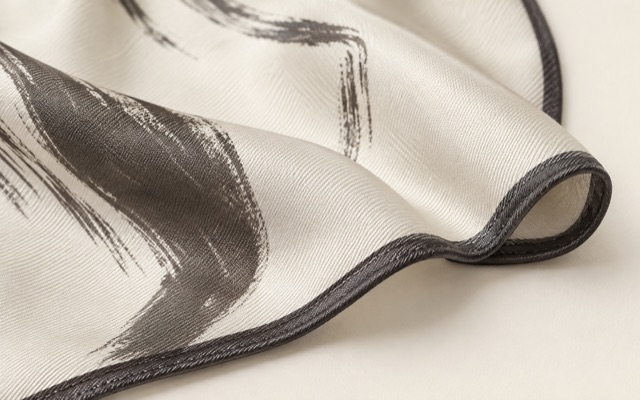
Hand-rolled and machine-hemmed routes create different visual and production results. The decision can affect edge profile, stitch appearance, corners, finished dimensions, handling and cost. Avoid choosing from the name alone. Review an edge sample in the intended material and product scale, then specify roll or fold direction, width reference, thread relationship, stitch appearance and corner expectation.
Artwork close to the edge needs the selected construction. The amount of visual loss or movement cannot be set from a generic website rule. Use the approved template, keep essential text and marks inside the agreed safe area, and inspect border centring on the physical sample.
Connect material and edge to care and labelling
The buyer is responsible for confirming requirements in each selling market, with suitable professional advice where needed. For the United States, FTC textile rules and guidance address fibre-content, country-of-origin and business-identity labelling. Other markets may require different wording, languages, care information or documentation. Do not copy a label from another product and assume it applies.
Ask who supplies the verified fibre statement, who prepares label artwork, where the label will be placed and which sample includes it. A care instruction should correspond to the actual material, colour, print and finish rather than a generic silk statement.
Material-and-edge briefing checklist
A specification can begin with open questions. The important step is to keep those questions visible until a sample and written order record resolve them.
Review checklist
- Intended product, size, use and price position.
- Silk, polyester or a request for recommendation.
- Composition and construction stated separately.
- Weight reference and how it will be confirmed.
- Desired surface, opacity, drape and reverse appearance.
- Print route and physical colour-reference plan.
- Hand-rolled or machine-hem direction, with sample checkpoints.
- Destination markets and required label or document review.
Primary references
Sources used for technical context
These sources support the general technical or regulatory context. They do not prove SCARFTEX capability, certification or the specification of a particular order.
- Electronic Code of Federal Regulations — 16 CFR Part 303
Primary U.S. legal text for textile fibre-product identification requirements.
- U.S. FTC — Threading Your Way Through the Labeling Requirements
Primary regulator guidance used for the U.S. labelling context.