Direct answer
Start with the decision, then verify the specification.
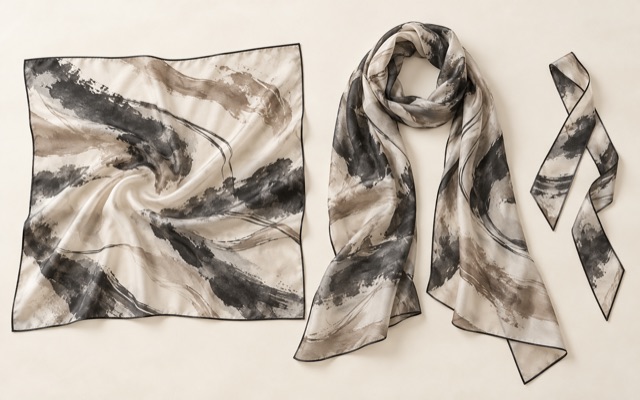
A coherent scarf collection reuses a visual system, not one unchanged layout. Preserve recognisable colours, motifs and border logic, then redraw the hierarchy for each finished proportion. Give every format its own specification, sample decision, quantity and approval record. SCARFTEX's standard custom-scarf MOQ is 50 pieces per style, per colourway for silk and polyester; the same minimum applies to custom accessories, while packaging and original design work are confirmed separately.
Buyer scenario
Why this question changes the order.
A brand wants one successful square-scarf print to become a twilly and a long scarf. A quick crop removes the focal motif from the twilly, while stretching the square makes the long version look distorted. Treating colour, motifs and border logic as a shared system—and redrawing each proportion—creates a recognisable collection without forcing one layout into incompatible shapes.
Assign a commercial role to each format
Start with the range architecture before adapting artwork. One format may be the image-led hero product, another an accessible entry item, and another a gifting or styling extension. A 90 cm square can carry a broad narrative; a twilly may function as a bag, hair or neck accent; a long scarf can create a directional story across its length. Those roles tell the designer what must remain recognisable and what may change.
Avoid adding formats simply to make a range appear larger. Every additional size, colourway, edge route, label or pack-out creates a separate specification and approval task. A concise collection with clear roles is often easier for a buyer to merchandise and easier for the project team to control.
Build a visual system before resizing
List the assets that define the story: core palette, hero motif, secondary motifs, line weight, border family, typography rules and brand mark. Then decide which are fixed and which may move. A square might use a central medallion and four corners, while a narrow format may repeat one secondary motif and convert the border into a pair of rails. Both can feel related without pretending they share the same composition.
Automatic cropping is risky because it can remove the focal point, cut a motif at an awkward location or create an empty band. Stretching is worse: it changes proportions and can distort logos or illustrative line work. Redraw, repeat or reposition with the finished outline visible.
Compare square, narrow and long proportions
Use this comparison as a briefing framework, not as a fixed recommendation. The buyer's use, price position, material and artwork should determine the selected format.
| Option | Best considered for | Watch point |
|---|---|---|
| Square | Full compositions, borders, diagonal folds and multiple wearing routes | Central motifs may disappear after folding; borders sit close to finishing. |
| Narrow / twilly | Bag handles, hair, wrist and compact neck accents | Very small details and wide borders can overwhelm the available field. |
| Long / oblong | Directional repeats, neck drape, travel and layered styling | End treatments, repeat joins and orientation need deliberate planning. |
| Coordinated accessory | Gift sets and brand storytelling | Construction, component minimums and packaging are not automatically shared with the scarf. |
Control colourways as versions
Creating colourways is more than changing a background swatch. Contrast relationships, fine details and the visual balance of the border may change. Give each colourway a unique name or code and keep its latest artwork, physical reference and approval decision together. If one colourway is revised, do not silently overwrite the others.
Plan whether the collection needs a stable core palette, seasonal rotations or both. A core version can support continuity, while seasonal versions can refresh the story. Reorder matching still requires retained references and written confirmation; a previous website image is not a production colour standard.
Write a separate specification for every product
A shared artwork story does not create a shared product specification. For each style record finished dimensions and measurement method, fibre composition, construction, weight reference, print route, edge, label placement, packaging and quantity by colourway. Identify which elements are buyer-supplied and which require development.
Sampling should answer the highest-risk decision for each format. A printed strike-off may help with colour and detail, while a sewn prototype can answer size, edge, label and wearing questions. The sample route, included quantity, fee and approval scope should be written before work starts. Timing is confirmed for the selected project and starts after the project details are confirmed and the sample fee has been received.
Plan MOQ by style and colourway
For SCARFTEX custom silk and polyester scarves, the confirmed standard MOQ is 50 pieces per style, per colourway. Two sizes are two styles for planning purposes unless a written quotation states otherwise. Two colourways are also separate quantity lines. Do not assume that 25 pieces in one colour and 25 in another satisfy a 50-piece minimum.
A project may still be quoted as one collection, but the commercial breakdown should expose each line. Labels, gift boxes, pouches and other packaging components can have their own minimums, setup costs and timing. Ask for these components to be listed separately so a packaging minimum is not mistaken for a scarf minimum.
Range adaptation checklist
The goal is a family resemblance with product-level discipline. A buyer should recognise one collection while still understanding exactly what is being ordered, sampled and approved.
Review checklist
- Each format has a clear buyer, use and role in the assortment.
- Fixed visual assets and adaptable visual assets are documented.
- Artwork is redrawn for proportion rather than stretched or blindly cropped.
- Every style and colourway has a controlled file name and specification.
- Sample type is chosen according to the decision it must answer.
- MOQ is calculated by style and colourway; component minimums are separate.
- Reorder references and rights for artwork use are recorded.
Primary references
Sources used for technical context
These sources support the general technical or regulatory context. They do not prove SCARFTEX capability, certification or the specification of a particular order.
- WIPO — Copyright
Primary international background for treating artwork rights and permissions as explicit project records.