Direct answer
Start with the decision, then verify the specification.
Treat the scarf, sewn-in information, removable retail elements and protective transit packing as four linked but separately specified workstreams. Start with the destination market and sales channel, then define the content, dimensions, materials, colour, position and attachment method for every label or pack component. Ask the quotation to show separate minimums, sampling charges and timing for each component. SCARFTEX's confirmed custom-scarf minimum is 50 pieces per style, per colourway for silk and polyester scarves; that figure does not automatically establish the minimum for woven labels, printed care labels, hangtags, barcodes, boxes, pouches or other packaging. Those items must be confirmed for the selected specification.
Buyer scenario
Why this question changes the order.
Imagine an online fashion label planning two scarf colourways for its own store and selected boutiques. The scarf quantity may fit the custom minimum, while a rigid box printer, woven-label maker or barcode workflow may require a different quantity. If the buyer writes only 'branded packaging', suppliers can price completely different scopes. One may include a generic bag and sticker; another may include a custom box, tissue, insert and carton labelling. The offers are not comparable, and the packaging with the longest approval or production path may quietly become the schedule driver.
Separate product identity from presentation
A sewn brand label, fibre or care label, hangtag, barcode sticker and gift box do different jobs. Record each as its own line in the brief. For sewn components, specify finished size, fold type, substrate, artwork, colours, text, language, placement, orientation and attachment. For removable items, add hole, cord, seal or adhesive details. For packaging, state whether it is protective, retail-facing, gift-ready, e-commerce-ready or intended for direct-to-customer fulfilment.
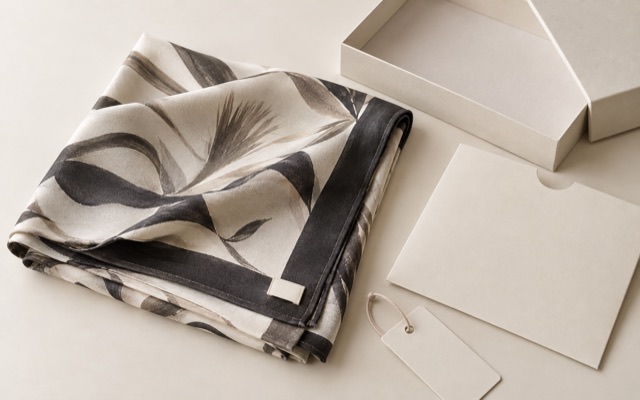
Do not use a packaging image as the specification. A photograph rarely settles board thickness, surface paper, print method, internal dimensions, insert construction, closure, barcode position or transit protection. A written specification and an approved physical reference should work together. If an item is optional, ask for the base scarf price and the option as separate lines so the commercial decision remains visible.
Confirm market information before artwork release
The brand or importer should identify the market in which the scarf will be sold and obtain market-specific compliance advice before final label artwork is released. Requirements can differ by product classification and jurisdiction. In the United States, the FTC publishes textile-labelling guidance covering matters such as fibre content, country of origin and responsible business identity for covered textile products. The EU Textile Regulation governs textile fibre names and related fibre-composition labelling in its scope. These sources are starting points, not a legal opinion about a particular scarf.
Give the production team approved wording rather than asking it to decide legal content. Mark which text is fixed, which languages are required, who owns barcode data and who signs off care instructions. Check that a logo or marketing claim does not contradict the declared fibre composition. If the buyer has not yet confirmed the legal text, keep the physical label construction review separate from the final printed-content approval.
Choose the right proof for each decision
A digital layout can check spelling, position and proportional scale, but it cannot prove the hand feel of a woven label, the stiffness of a hangtag, the fit of a scarf inside a box or the way tissue creases. A plain structural sample can answer dimensions, opening, folding and product fit before print. A printed packaging sample can answer colour, finish, barcode readability and final presentation. A sewn construction sample can show whether a label irritates the wearer, distorts the edge or remains visible after folding.
Define the approval sequence in the quotation: artwork proof, structural sample, printed sample and final packing reference as applicable. Scarf-sampling timing is confirmed per project and starts once project details are confirmed and the sample fee has been received; the exact route, day basis, delivery treatment and schedule are stated in the sample brief. Packaging and label sampling may follow different clocks.
Make minimums and leftovers explicit
Ask for the minimum and price break of every branded component, not only the finished scarf. Record whether the minimum is calculated per label design, language, barcode, box artwork or packaging size. If quantities can be combined across colourways, require that rule in writing. If a component must be purchased above the scarf quantity, identify who owns the excess, how it is counted, where it may be stored, how long it can be held and what happens if the artwork changes.
Leftover labels or boxes are not automatically an advantage. They may reduce a future component purchase, but a changed address, fibre statement, care instruction, barcode, colour, product size or legal requirement can make them unusable. Reorders should therefore begin with a documented stock count and version check rather than an assumption that old components can be reused.
Buyer checklist before requesting a quote
Review checklist
- List every component: sewn brand label, care or fibre label, hangtag, barcode, inner protection, retail pack, insert and export carton marks.
- Provide approved wording, artwork files, colours, dimensions, language versions and destination markets.
- State sales channel, folding method, pack quantity, gift presentation and direct-to-customer requirements.
- Request a separate MOQ, unit price, setup or tooling charge, sample fee and lead-time line for each component.
- Define the proof or physical sample needed to approve construction, print, fit, attachment and pack-out.
- Confirm who supplies barcode data and who verifies the final code and human-readable text.
- Record ownership, storage and version-control rules for any excess branded materials.
- Keep final bulk packing tied to an approved reference and written specification.
Primary references
Sources used for technical context
These sources support the general technical or regulatory context. They do not prove SCARFTEX capability, certification or the specification of a particular order.