Direct answer
Start with the decision, then verify the specification.
Snag resistance is not determined by fibre name or price alone. It depends on yarn, weave, surface floats, density, finishing, print contrast and the sharp or rough objects encountered in use. A smooth satin face may deliver the drape and lustre a collection wants while exposing longer floats to a different snag risk than a tighter twill; that is a trade-off to sample, not a reason to label one construction universally better. Define the contact scenario—rings, bracelets, bag hardware, hook-and-loop, rough nails, display fixtures or packing edges—then compare representative finished samples. If a formal method is required, agree its suitability, edition, rating approach and acceptance level. Keep laboratory comparison, practical handling and visual defect standards connected but separate.
Buyer scenario
Why this question changes the order.
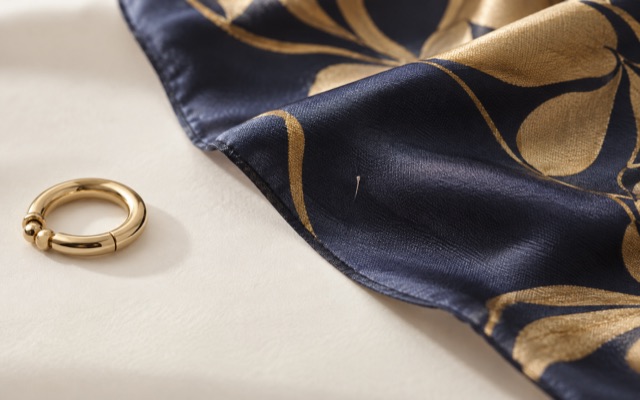
A luxury gift scarf passes artwork and colour review, then complaints appear after wear: fine loops show near the shoulder where a chain strap crosses the fabric. The scarf is not necessarily defective by an unstated universal rule; the specification simply never addressed the intended contact. The brand now needs to decide whether to change the fabric construction, artwork contrast, use guidance, accessory pairing or acceptance limit. A short wear-risk review before final material selection would have made that decision while alternatives were still affordable.
Understand what a snag changes
A snag is a yarn or filament pulled from the fabric surface by contact with another object. Its appearance may be a loop, protruding thread, local distortion, run or visible line. On a scarf, even a small pull can become conspicuous when it crosses a clean border or a high-contrast field. The physical disturbance and the visual consequence should both inform evaluation; simply counting marks can miss why one defect is acceptable and another dominates the product.
Risk is affected by construction. Fabrics with longer surface floats can offer a smooth, lustrous face, but those exposed yarn paths may interact differently with jewellery or rough hardware from more interlaced constructions. Yarn type, twist, density and finishing also matter. Because several variables change together, a buyer should compare named fabric options on the same intended product rather than relying on a generic statement that ‘silk snags’ or ‘twill is durable’.
Start with the real contact map
List where and how the scarf will be used. A neck scarf may meet earrings, necklace clasps, coat zips and bag straps. A twilly may rub against buckles, handles and corners. A headscarf may encounter pins, magnets, hair accessories or textured outerwear. A retail display can introduce hooks, clips and repeated customer handling before the product is sold. Each contact map suggests different sampling and handling checks.
The brand can then decide what it wants to protect most: pristine appearance, repeatable daily wear, a particular high-lustre surface or compatibility with a known accessory. This is a design decision as much as a quality decision. If the satin look is essential, the response might be artwork placement, construction adjustment, a handling instruction or a defined tolerance—not automatically replacing the material. State the intended compromise instead of asking for maximum softness, maximum shine and maximum snag resistance without trade-offs.
Choose laboratory comparison with care
ASTM D3939/D3939M describes a mace method for determining snagging resistance of fabrics and notes that results may be used for quality control and product comparisons. It also records limitations, including poor between-laboratory precision for commercial acceptance and the need to consider whether the method suits the fabric and end use. This makes the method useful context, not an automatic clause to paste into every scarf order.
If formal testing is justified, ask a qualified laboratory to confirm the relevant method and current edition, specimen preparation, number and direction of specimens, conditioning, evaluation and reporting. Agree whether the method is being used to rank candidate fabrics, establish a baseline or accept production. Do not convert a single reported grade into a marketing claim without defining the tested article. If different laboratories may be involved, discuss comparability before using small numerical differences to select a fabric.
Pair controlled testing with a use-led trial
A controlled test can make options more comparable, while a wear or handling trial can reveal the exact contacts created by the product. Build a small protocol around the intended use: tie the scarf in the priority style, wear it with the nominated jewellery or uniform, place a twilly on the selected bag hardware, and inspect named zones after a defined period. Record the sample code, fabric, colourway, wearer conditions and observations rather than relying on memory.
The trial is not a laboratory certificate and should not be presented as one. Its value is in finding interactions a generic method may not reproduce. A rough display hook, unpolished box edge or ring setting can create an immediate practical problem even when a comparative fabric result is satisfactory. Conversely, an aggressive test may create defects that are not representative of normal use. Use both forms of evidence for their intended purpose.
Write a visual defect standard before inspection
The quality plan should describe loops, pulls, runs, broken filaments and distortion with photographs or approved limit examples where possible. Identify high-visibility zones such as borders, logos, central motifs and hanging ends. Define whether defects are assessed flat, at a viewing distance, under stated lighting or in the priority fold. A bright pulled filament on a dark ground may be more visible than the same physical disturbance inside a complex print.
Inspection also needs a handling environment that does not create the defect being checked. Clean smooth tables, protected measuring tools, appropriate gloves where required and jewellery-free handling reduce accidental damage. Review needles, pins, clips, cartons and display components. If a bulk finding exceeds the agreed limit, the remedy path—sorting, replacement, rework where feasible or commercial review—should already exist in the purchase terms.
Design the retail and care story around realistic wear
A product page or care card can help customers handle a delicate scarf, but the language should match the approved material and intended use. Guidance may address storage away from rough hardware, careful removal of rings during styling, or avoiding hook-and-loop closures. It should not imply that any contact voids responsibility or that a fine accessory must remain unused to stay saleable. Premium positioning is stronger when the product and the care message are designed together.
For programmes that include bag ties or uniform accessories, review the hardware itself. Rounded, polished surfaces and protected attachment points may be as important as fabric choice. If the scarf is supplied with a ring, clip or gift-box fixture, include that component in handling trials and inspection. A snag-risk decision belongs to the complete offer the customer receives, not only to a fabric swatch selected months earlier.
Compare options without losing the design objective
Prepare at least two realistic samples when snag risk is important: for example, the preferred lustrous construction and a tighter or differently finished alternative. Keep dimensions, artwork scale and edge route as consistent as possible. Ask reviewers to score drape, surface character, print appearance and snag observations separately. This stops a more resistant option from winning automatically if it no longer delivers the collection's intended look or wearing behaviour.
Dark plain areas, sharp geometric borders and large fields of one colour can make surface disturbance easy to see. A complex print may visually soften a minor pull but should not be used to hide unacceptable damage. During design development, place critical logos and faces away from high-contact zones where possible. The goal is not to camouflage poor quality; it is to understand how construction, artwork and wear combine in the finished object.
Record the accepted limitation in product and customer-service planning. A delicate evening scarf and a daily uniform accessory can both be well designed, but they should not share an unstated durability expectation. Clear internal positioning helps purchasing choose the right evidence, marketing avoid exaggerated claims and customer service respond consistently if a pull appears. The material choice becomes intentional rather than merely luxurious-sounding.
Buyer checklist for snag risk
Review checklist
- Map expected contact with jewellery, bag hardware, zips, pins, display hooks and packaging edges.
- Compare named constructions and weights in the finished product, not fibre names in isolation.
- Review how artwork contrast and visible zones change the appearance of a pull.
- Confirm whether a proposed snag method is suitable for the fabric and purpose.
- Use controlled testing for comparison and a documented handling trial for the priority use.
- Agree visual defect examples, inspection conditions and high-visibility zones.
- Protect samples and bulk goods with clean, smooth, jewellery-free handling surfaces.
- Record any material or finishing change that requires the snag decision to be reopened.
Primary references
Sources used for technical context
These sources support the general technical or regulatory context. They do not prove SCARFTEX capability, certification or the specification of a particular order.
- ASTM D3939/D3939M-26 — Snagging resistance of fabrics (Mace)ASTM International
Describes a snagging-resistance method and its important suitability and precision limitations.