Direct answer
Start with the decision, then verify the specification.
Persistent creasing after transit is a combined material, product and pack-out issue. Define how the scarf should look when first opened, how long it may remain folded, which fold lines are acceptable, and whether the customer can reasonably expect them to relax, hang out or require care. Compare finished material options, then test the selected folding method, tissue, board, pouch or box using the actual scarf dimensions. AATCC TM66 provides a controlled way to measure wrinkle recovery angle in woven fabrics, but a buyer still needs a pack-out trial because a small laboratory specimen cannot reproduce every fold, edge, pressure and dwell time inside a retail box. Approve the product and packaging as a system before carton dimensions and shipment are final.
Buyer scenario
Why this question changes the order.
A travel retailer chooses a compact box to reduce volume and create a neat shelf footprint. The scarf fits, but the centre is folded repeatedly, the rolled edges press against one another and the box remains closed through warm storage and international transit. On arrival, the product carries hard geometric lines that dominate the first presentation. Neither the fabric sample nor the flat packaging mock-up answered that question. A packed-sample trial with a defined recovery review would have shown whether to alter the box, fold, material or customer presentation.
Define the opening moment
Creases are not judged in a vacuum. A tightly folded travel scarf, a gift-set wrap and a boutique square displayed flat have different first-use expectations. Write the presentation target: smooth enough to wear immediately, acceptable after a stated hanging period, intentionally softly folded, or designed to be steamed by trained retail staff. Avoid promising ‘wrinkle free’ unless a defined material and test evidence support the exact claim.
Also define who opens the pack and where. A warehouse team may have time to hang or refold goods; a direct-to-consumer parcel is judged within seconds. A corporate gift may stay sealed for months. The longer and more constrained the storage, the more important it is to test the full pack. This buyer context should be available during material and packaging selection, not added after the box artwork has been approved.
Distinguish recovery from care
Wrinkle or crease recovery describes how a fabric returns after deformation under defined conditions. Care instructions describe what a user may safely do. They are related but not interchangeable. A fabric that shows reasonable recovery in a controlled test may still carry a sharp pack fold, while an instruction to steam may be inappropriate for the customer, print, edge or packaging context unless verified. Do not use a care remedy to excuse a preventable packing problem.
AATCC TM66 folds and compresses a woven specimen under controlled time and force, suspends it for a controlled recovery period and records the recovery angle. That can help compare candidate fabrics or monitor consistency. It does not by itself establish the visual acceptability of a finished printed scarf after weeks in its retail pack. The project must define whether the laboratory result is comparative information, a specification requirement or both.
Design the fold around the scarf
Map the finished dimensions, border, rolled or machine-finished edges, label position, key motifs and customer opening action. Avoid concentrating multiple folds in the same small zone where possible. Check that rolled edges are not crushed under a heavy stack and that a sewn label does not leave an impression on the face. A square, long scarf and twilly should not inherit the same folding diagram simply because they share a box family.
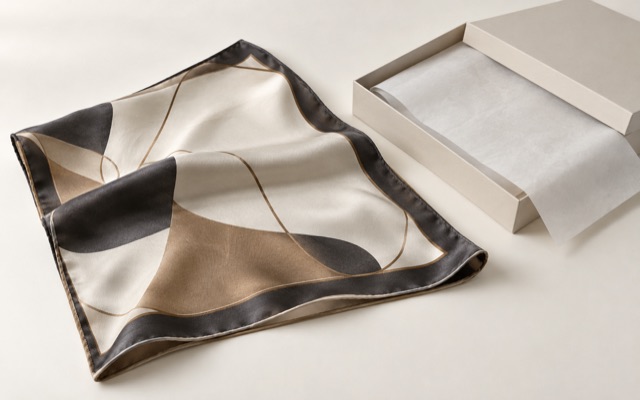
Packaging components can redistribute pressure. Tissue may reduce direct surface contact but can introduce its own lines if bunched. A board can support a clean fold while adding stiffness and weight. A pouch can allow a looser shape but may move inside a larger carton. The correct route depends on presentation, freight volume, storage, material and assembly. Request a physical pack-out sample rather than approving components only as separate objects.
Run a realistic packed-sample trial
Use the actual or representative scarf, final folding method and intended pack components. Record sample code, material, size, finish, colourway, fold diagram, box internal dimensions, number of units stacked, closure, storage orientation, dwell time and environmental conditions available. The trial can include a controlled compression or distribution simulation if a qualified packaging adviser recommends it, but the protocol should match the business question rather than perform theatre around an undefined standard.
After opening, inspect immediately and at stated recovery intervals. Photograph the same zones in consistent light and note whether the crease affects artwork, border, edge, hand feel or saleable presentation. If steaming or hanging is part of the agreed route, test and document it on the selected article. Record who is expected to perform that action and whether it is realistic for retail staff or the end customer.
Connect retail packing to the shipping carton
A retail box that performs well alone can behave differently inside an export carton. Carton quantity, orientation, void fill, stacking and humidity exposure can affect pressure and movement. Final freight data also changes when a larger box or board is selected. The packaging decision therefore belongs before the freight quotation is treated as final. Ask for estimated data early, then refresh it after the pack-out is approved.
Pre-shipment review should confirm the folding reference, component versions, units per carton, carton dimensions and weights, and a sample of opened product from packed goods. If the product is expected to recover after opening, state the observation interval and acceptance rule. A photograph taken immediately after a scarf is unfolded may not represent the agreed review condition; equally, waiting until all lines disappear can conceal a poor opening experience.
Plan for travel retail, e-commerce and gifting separately
Travel retail rewards compact packs but may expose goods to repeated handling and long storage. E-commerce adds parcel vibration, compression from mixed orders and an unboxing moment without trained staff. Corporate gifting may keep products sealed until an event and may require fast distribution with no time for steaming. A single attractive box can serve more than one channel only if those conditions have been reviewed rather than assumed.
If one scarf will use several channels, keep the product specification stable and create documented pack variants where necessary. Name the folding and component version for each SKU, and prevent warehouse substitution between apparently similar boxes. The cleanest solution may be a common protective inner fold with different outer presentation. Whatever the route, approval should show how the buyer receives the scarf, not only how the empty package looks in a design presentation.
Use an approval sequence that leaves room to change
Review crease behaviour early with material swatches, then repeat the decision on a finished printed sample. Once dimensions and edge are stable, approve a folding study before investing in final printed packaging. The complete pack-out trial should occur before bulk packing and final carton data are locked. This sequence keeps low-cost learning early while still verifying the real product near the release point.
Every approval should state what it settles. A wrinkle-recovery comparison may select a fabric but not approve a box. A white structural box may approve internal dimensions and fold but not printed surface or final assembly. A retail sample may approve presentation but not distribution resistance. Naming these boundaries prevents one attractive prototype from being treated as evidence for every later condition.
If time is short, expose the remaining uncertainty rather than compressing it into a promise. The buyer may decide to accept a larger box, a softer fold, a shorter sealed dwell or a controlled retail preparation step. Record the decision, responsible party and affected channel. A transparent trade-off is more useful than a rushed ‘approved’ message that leaves the warehouse to discover the same crease after shipment.
Buyer checklist for crease control
Review checklist
- Define the expected appearance immediately after opening and after a stated recovery period.
- Identify how long goods may remain folded in warehouse, transit, retail and customer storage.
- Compare finished scarf materials as well as controlled fabric specimens.
- Approve a fold diagram for each format, size, edge and label arrangement.
- Test scarf, tissue, board, pouch or box together using representative dwell and pressure.
- Photograph named zones at consistent recovery intervals and record any care action.
- Refresh carton and freight estimates after final pack dimensions are approved.
- Carry the fold reference and acceptance rule into pre-shipment inspection.
Primary references
Sources used for technical context
These sources support the general technical or regulatory context. They do not prove SCARFTEX capability, certification or the specification of a particular order.
- AATCC TM66 — Wrinkle Recovery of Woven Fabrics: Recovery AngleAmerican Association of Textile Chemists and Colorists
Summarises a controlled method for measuring recovery angle in woven fabrics.